'Police have been absolutely brutal': Capital turns battlefield as cops use tear gas, batons in clash with protesters
Source Entity
Latest News: Today's Latest News Headlines from India & World | Hindustan Times | Hindustan Times
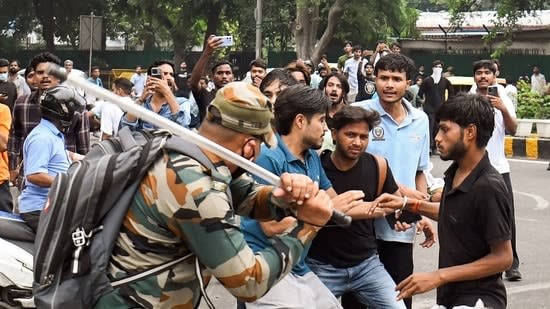
The Monsoon Session of Parliament faced immediate disruptions on its opening day due to massive protests over the NEET paper leak and Ram Temple donation theft. While police utilized force to contain tens of thousands of protesters in New Delhi, legislative work stalled, save for a bill to expand the Supreme Court.
Parliament Monsoon Session Paralyzed by Protests and Public Unrest
The Monsoon Session of Parliament commenced on July 20, 2026, under a cloud of intense political friction and civil unrest. The opening day was effectively a washout as Opposition parties, including Congress, the Samajwadi Party, and the Trinamool Congress, converged in the Well of the House to protest against the government. The primary triggers for this legislative deadlock were the alleged NEET paper leak and reports of donation theft at the Ayodhya Ram Temple, issues that have galvanized the Opposition and disrupted the standard proceedings of both the Lok Sabha and the Rajya Sabha.
The NEET Controversy and Public Mobilization
At the heart of the unrest is the NEET paper leak scandal, which has sparked widespread indignation among the youth. The Cockroach Janta Party (CJP) has spearheaded protests, demanding the immediate resignation of Union Education Minister Dharmendra Pradhan, citing systemic failures and CBSE exam irregularities. These grievances spilled out of the parliamentary chambers and into the streets of Lutyens’s Delhi, where an estimated 50,000 protesters challenged security cordons, leading to significant clashes with law enforcement across major thoroughfares like Ashoka Road and Janpath.
Legislative Stagnation and Security Response
Despite the chaos, the government attempted to maintain a semblance of legislative activity. Union Law Minister Arjun Ram Meghwal successfully introduced a Bill in the Lok Sabha aimed at replacing an Ordinance that increases the number of Supreme Court judges from 34 to 38. However, this was the sole item of business transacted as the House faced six consecutive adjournments before being called off for the day at 3 p.m. The security situation remained volatile, with police utilizing lathicharges, tear gas, and water cannons to disperse the massive crowds attempting to breach the perimeter of Parliament.
Opposition Dynamics and Fragmentation
The protest strategy within Parliament highlighted both unity and internal fractures. While major Opposition parties collectively stalled proceedings, the DMK notably diverged from the Congress-led strategy, focusing instead on the Mekedatu project issue. Furthermore, subtle shifts in the House, such as the changed seating arrangements for rebel Trinamool Congress MPs, signaled underlying political realignments that may complicate future legislative sessions. These dynamics suggest that the government will face a difficult path in passing its agenda if the Opposition maintains this unified front on social and educational issues.
Broader Implications and Future Trends
The intensity of the July 20 protests indicates a growing trend of street-level activism influencing parliamentary decorum. By linking the NEET paper leak to broader governance concerns, the Opposition has set a high-stakes tone for the remainder of the Monsoon Session. The government’s reliance on ordinances—such as the one concerning the expansion of the Supreme Court—suggests a desire to push through judicial reforms quickly, yet the current climate of protest indicates that the legislative process will remain highly sensitive to public pressure. As the session progresses, the government will likely need to balance its legislative goals with an increasingly vocal and mobilized public base demanding accountability on national examinations and religious institution management.
Multiple Citing Sources
Verification Required?