Montana rancher's dinosaur skeleton sells for $47.3m, 5 times top estimate
Source Entity
TOI WORLD DESK
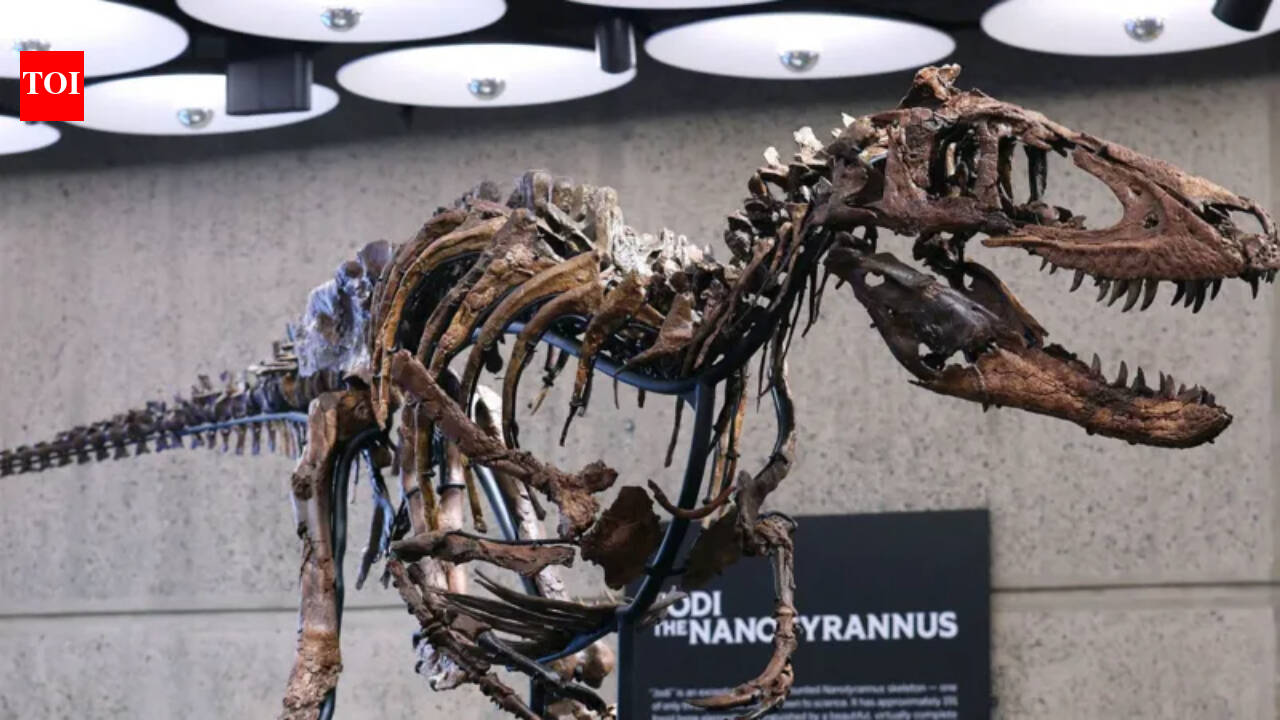
A rare Nanotyrannus skeleton named 'Jodi' sold for $47.3 million at a Sotheby's auction, far exceeding its $9 million estimate. This record-breaking sale has sparked intense debate regarding the impact of private collecting on scientific access to rare fossils.
The Record-Breaking Sale of 'Jodi' the Nanotyrannus
In a landmark event at Sotheby’s in New York, a rare dinosaur skeleton known as 'Jodi'—a Nanotyrannus—was sold for $47.3 million. This figure shattered the initial pre-auction estimate of $9 million, marking one of the highest prices ever paid for a fossil specimen. Discovered in 2019 on a ranch in Montana, the skeleton is nearly 70% complete and features a remarkably well-preserved, near-perfect skull, which has made it a focal point for both paleontologists and private collectors alike.
The Taxonomic Debate: Nanotyrannus vs. T. rex
For decades, the classification of Nanotyrannus has been a subject of significant academic dispute. Often overshadowed by its larger, more famous relative, the Tyrannosaurus rex, the Nanotyrannus represents a smaller, sleeker predator. Its existence and distinct classification have historically been caught between scientific debate, with some experts arguing it is a separate genus and others suggesting it may simply be a juvenile T. rex. The sale of such a high-quality specimen brings this niche, yet scientifically vital, debate back into the public eye.
The Economics of Paleontology
Twelve minutes of bidding between six participants culminated in the final $47.3 million sale price. This rapid escalation in value highlights a growing trend in the fossil market, where rare skeletal remains are increasingly treated as high-value assets for private investment. The sheer disparity between the $9 million estimate and the final price underscores how aggressive the market for prehistoric remains has become, moving from purely academic interest into the realm of luxury collectibles.
Scientific Implications and Access
As prices for specimens like Jodi continue to climb, the paleontological community has expressed significant concern. The primary fear is that wealthy private collectors will effectively remove these rare specimens from the public domain, making them unavailable for rigorous scientific research. When fossils are bought by private entities, they are often tucked away in personal galleries rather than deposited in museums or research institutions, potentially hindering our collective understanding of evolutionary history.
The Future of Fossil Discovery
This sale serves as a catalyst for a broader discussion regarding the ethics of fossil excavation and trade. Because the skeleton was found on private land in Montana, the owner retains legal rights to sell the fossil, a reality that creates a complex landscape for researchers who rely on these discoveries to advance their work. The case of Jodi highlights the tension between the rights of private landowners and the scientific necessity of preserving natural history for global study.
Conclusion
The $47.3 million sale of the Nanotyrannus skeleton is a watershed moment for the intersection of commerce and science. While the specimen’s preservation provides a unique opportunity to study a rare creature, the outcome of this auction emphasizes the increasing difficulty scientists face in securing access to prehistoric treasures. As the market for such items continues to expand, the global scientific community must grapple with how to ensure that future discoveries remain accessible to all, rather than becoming exclusive trophies for the few.
Multiple Citing Sources