How to pack ternary numbers in 8-bit bytes
Source Entity
Hacker News
This technical analysis explores methods for packing ternary numbers (trits) into 8-bit bytes to optimize storage and processing for BitNet b1.58. The approach focuses on balancing information density with SIMD-friendly unpacking performance.
Optimizing Ternary Data Representation for Modern Hardware
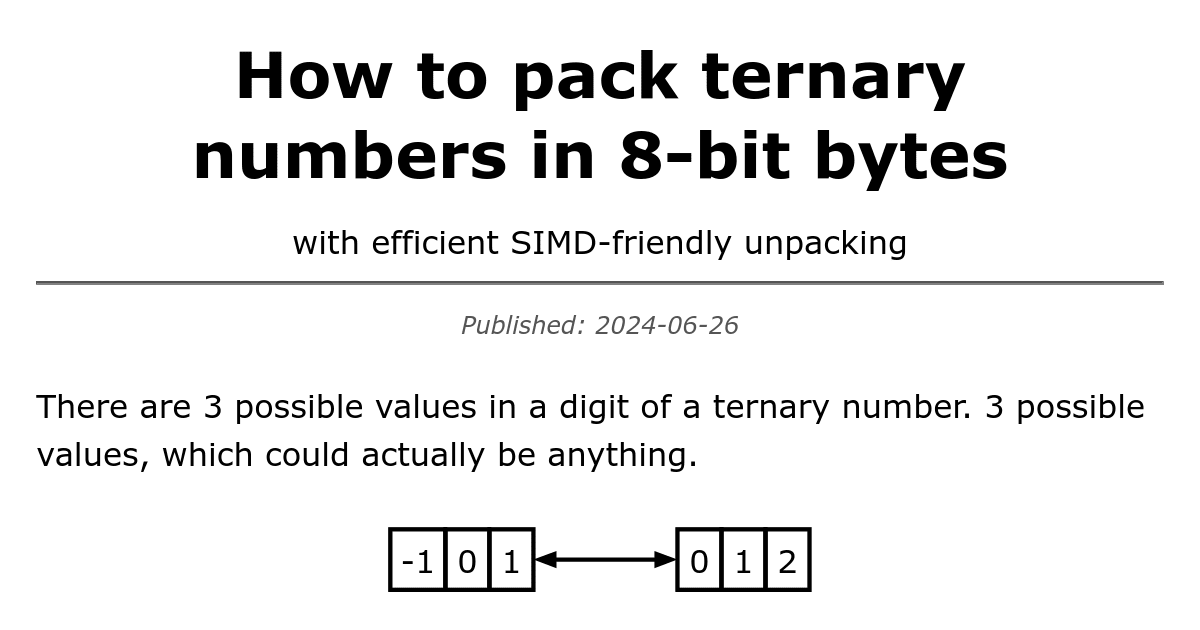
Recent advancements in large language model architectures, specifically BitNet b1.58, have necessitated a shift in how we handle data at the bit level. Unlike standard binary systems, ternary systems—using values like -1, 0, and 1—offer a more compact representation for certain neural network weights. The challenge lies in efficiently packing these 'trits' into standard 8-bit byte architectures that define modern computing.
The Mathematical Challenge of Trit Packing
At the heart of this endeavor is the pursuit of the theoretical information density limit, defined as log(3) / log(2) bits per trit. Because three states cannot be represented by a single bit, engineers must group trits into blocks to minimize wasted space. The goal is to pack these values as tightly as possible while ensuring that the resulting data structures remain compatible with standard byte-aligned memory access patterns.
Prioritizing SIMD-Friendly Architectures
Modern CPUs and GPUs rely heavily on SIMD (Single Instruction, Multiple Data) processing to accelerate mathematical operations. If a packing scheme creates blocks that are too large or computationally cumbersome to unpack, the performance gains from reduced memory usage are negated by the overhead of data retrieval. Therefore, the selection of a block size is not merely a mathematical exercise but a hardware-specific optimization strategy.
Finding the Ideal Block Size
To achieve efficient unpacking, one must identify a block size that aligns with both information density goals and hardware convenience. This involves finding powers of 3 that map effectively onto 8-bit or larger register widths. By selecting a block size that allows for fast, parallelized unpacking, developers can ensure that the BitNet b1.58 weights are ready for computation without significant latency penalties.
Broader Implications for AI Infrastructure
This research into ternary packing represents a critical step toward more efficient AI inference. As models grow in parameter count, the ability to store weights in a ternary format rather than traditional floating-point representations significantly reduces the memory bandwidth bottleneck. This optimization is essential for deploying large models on edge devices or hardware with constrained memory resources.
Future Trends in Compressed Computing
Looking forward, the techniques used to pack ternary numbers into bytes will likely inform future hardware design. We may see an increase in instruction sets specifically designed to handle non-binary data types, further narrowing the gap between theoretical information density and practical implementation. Mastery of these low-level packing techniques is the next frontier in high-performance machine learning.