Show HN: Samosa – Linter for Math Derivations
Source Entity
Hacker News
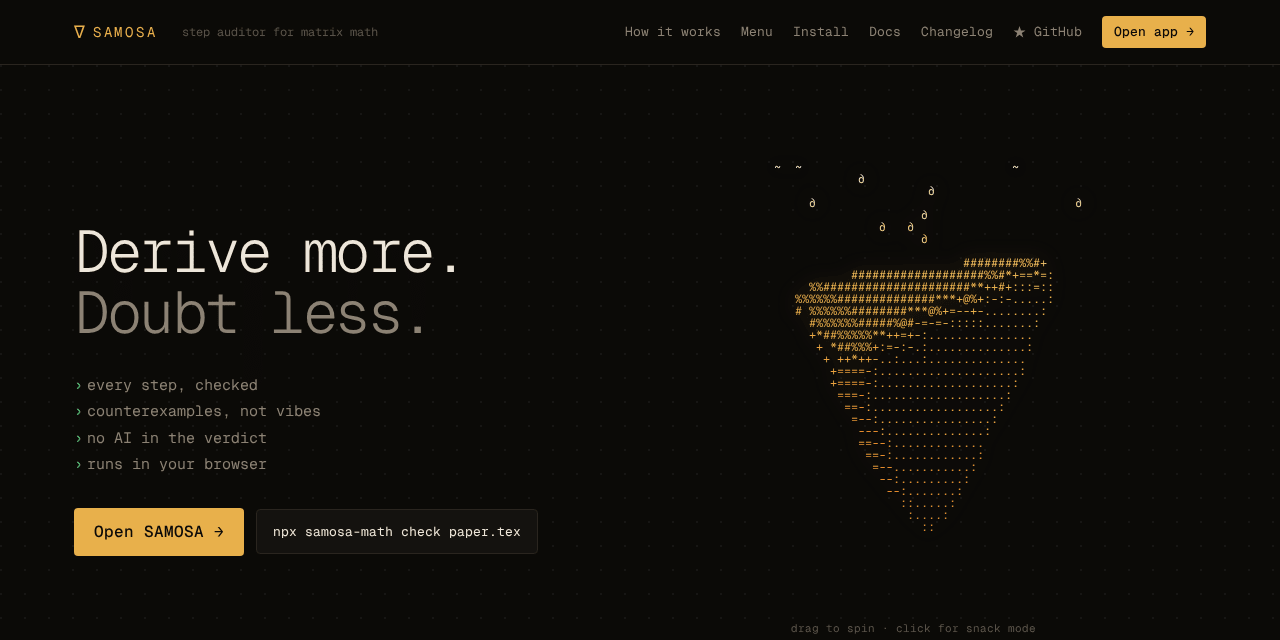
Samosa is a newly introduced linter designed to verify and validate mathematical derivations. It aims to assist users in identifying logical errors within complex mathematical proofs and calculations.
Bridging the Gap Between Code and Proofs
The introduction of 'Samosa,' a linter specifically designed for mathematical derivations, marks a significant intersection between formal methods in software engineering and the rigorous field of mathematics. Traditionally, linters have been the exclusive domain of programmers, used to enforce stylistic consistency and catch common syntax errors in source code. By applying this paradigm to mathematical derivations, the developers of Samosa are addressing a long-standing challenge: the inherent difficulty of manually verifying step-by-step logical proofs.
The Mechanics of Mathematical Linting
At its core, Samosa functions by parsing mathematical steps to ensure that transitions between equations adhere to established logical rules. In many academic and professional settings, a single arithmetic error or a skipped logical step can invalidate an entire derivation. By automating the 'linting' of these processes, Samosa acts as an essential quality-assurance tool, potentially reducing the cognitive load on researchers and students who must otherwise perform exhaustive manual checks.
Impact on STEM Education and Research
For the educational sector, the implications are profound. Students often struggle with the transition from intuitive understanding to formal proof writing. A tool like Samosa provides immediate feedback, allowing learners to identify exactly where their logic diverges from valid mathematical principles. In professional research, this could accelerate the peer-review process, as authors could use the tool to pre-verify their work before submission, ensuring a higher standard of accuracy from the outset.
Historical Context of Formal Verification
This development aligns with the broader historical trend of formal verification, which has been gaining momentum since the inception of computer-aided proof assistants like Coq and Lean. While those platforms are designed for full-scale theorem proving, Samosa appears to occupy a more accessible niche, focusing on the derivation process itself. This reflects a shift toward making formal verification tools more user-friendly and applicable to day-to-day mathematical tasks rather than just highly specialized academic research.
Future Trends in Mathematical Tooling
Looking ahead, we can expect to see more integration between natural language processing and mathematical verification. As tools like Samosa evolve, they may eventually support natural language inputs, allowing users to write proofs in plain English while the underlying engine checks for logical consistency. This could democratize access to high-level mathematics, making complex derivations accessible to a wider audience and significantly lowering the barrier to entry for scientific discovery.
Conclusion
In summary, Samosa represents a promising step toward the digitization and automation of mathematical rigor. By borrowing the linter model from software development, it provides a practical solution to the persistent problem of error detection in proofs. As the tool matures, its adoption could lead to a more robust, error-free environment for both mathematical education and advanced scientific inquiry.