The world's biggest solar telescope caught vortexes on the Sun's surface
Source Entity
Jacek Krywko
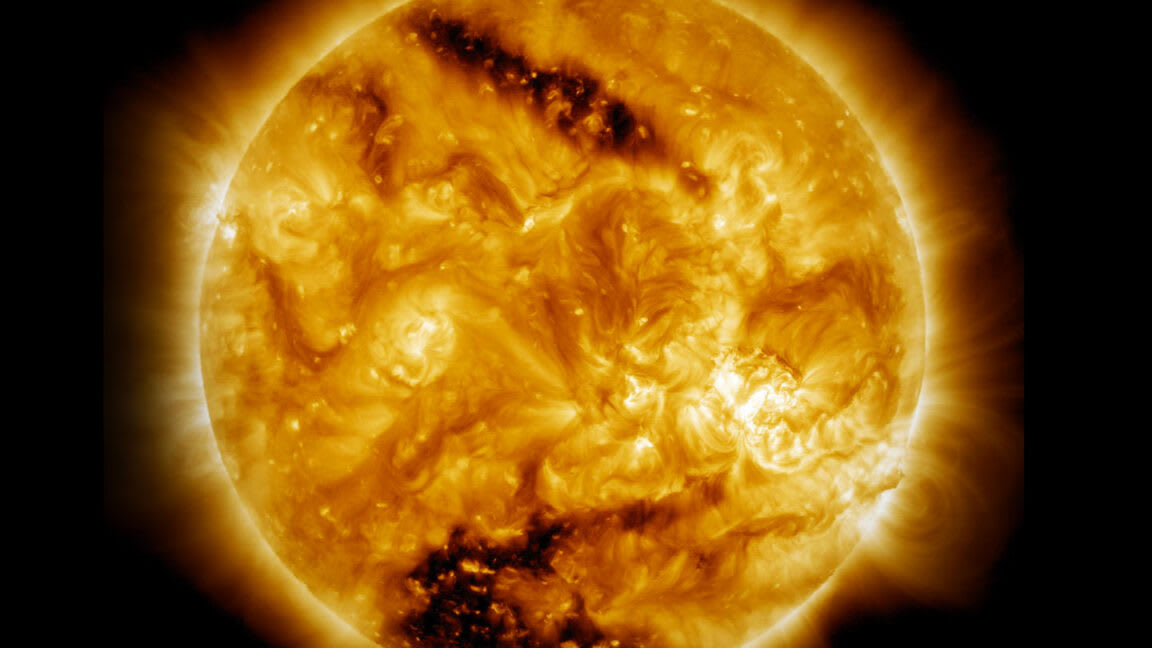
The National Solar Observatory has captured the first-ever visual evidence of Kelvin-Helmholtz instabilities on the Sun's surface. This discovery confirms long-standing theoretical predictions and could fundamentally alter our understanding of solar heat and magnetic energy transfer.
Unveiling Solar Vortexes: A New Era in Heliophysics
The recent observations from the world's largest solar telescope have provided the first concrete evidence of Kelvin-Helmholtz instabilities occurring on the surface of the Sun. For decades, solar physicists have theorized that the interaction between solar plasma layers moving at varying speeds should generate these characteristic curls and rolls, much like those seen in terrestrial cloud formations or water ripples. Until now, these phenomena were too small and fleeting to be captured by existing instrumentation, leaving a significant gap in our empirical understanding of solar dynamics.
The Physics of Kelvin-Helmholtz Instabilities
The Kelvin-Helmholtz instability is a fundamental fluid dynamic principle, first mathematically described in the late 19th century. It occurs when velocity shear exists within a continuous fluid or when there is a sufficient velocity difference across the interface between two fluids. While we observe these patterns regularly in Earth’s atmosphere and oceans, applying these principles to the Sun's turbulent, plasma-dominated environment has been a theoretical exercise rather than an observational reality. The confirmation by researchers David Kuridze and Friedrich Wöger bridges this gap, proving that these instabilities are not just occasional anomalies, but a ubiquitous feature of the solar surface.
Technological Breakthroughs in Solar Observation
This discovery was made possible by the unprecedented resolution of the world’s most advanced solar telescope. By overcoming the limitations of previous imaging technology, the National Solar Observatory team was able to resolve structures that were previously invisible. This advancement represents a major milestone in observational astronomy, as the ability to track these vortexes provides a new window into the complex, small-scale processes that govern the Sun's outer layers.
Implications for Solar Energy and Heat Transfer
The presence of these vortexes suggests that the Sun’s surface is far more dynamic than previously thought. The study indicates that these instabilities play a critical role in how heat and mass are distributed across the solar surface. By facilitating the mixing of plasma layers, these vortexes may act as a mechanism for transporting energy from the interior to the outer atmosphere, potentially helping to explain the enigmatic heating processes of the solar corona.
Future Trends in Heliophysics
Moving forward, these findings are expected to reshape numerical models of the Sun. Scientists can now incorporate real-world data regarding these instabilities into simulations, leading to more accurate predictions of solar activity and magnetic field evolution. As we continue to refine our understanding of these plasma vortexes, we may gain deeper insights into space weather, which has direct implications for satellite operations, communication systems, and power grids on Earth.
Conclusion
The identification of Kelvin-Helmholtz instabilities on the Sun marks a triumph for both theoretical physics and modern observational technology. By confirming that the same fluid dynamics governing wind and water on Earth also dictate the behavior of solar plasma, researchers have opened a new chapter in heliophysics. This discovery not only validates decades of scientific speculation but also provides a vital new variable in the complex equation of solar energy transfer.