Classification of Finite Simple Groups Formalized in Lean
Source Entity
Hacker News
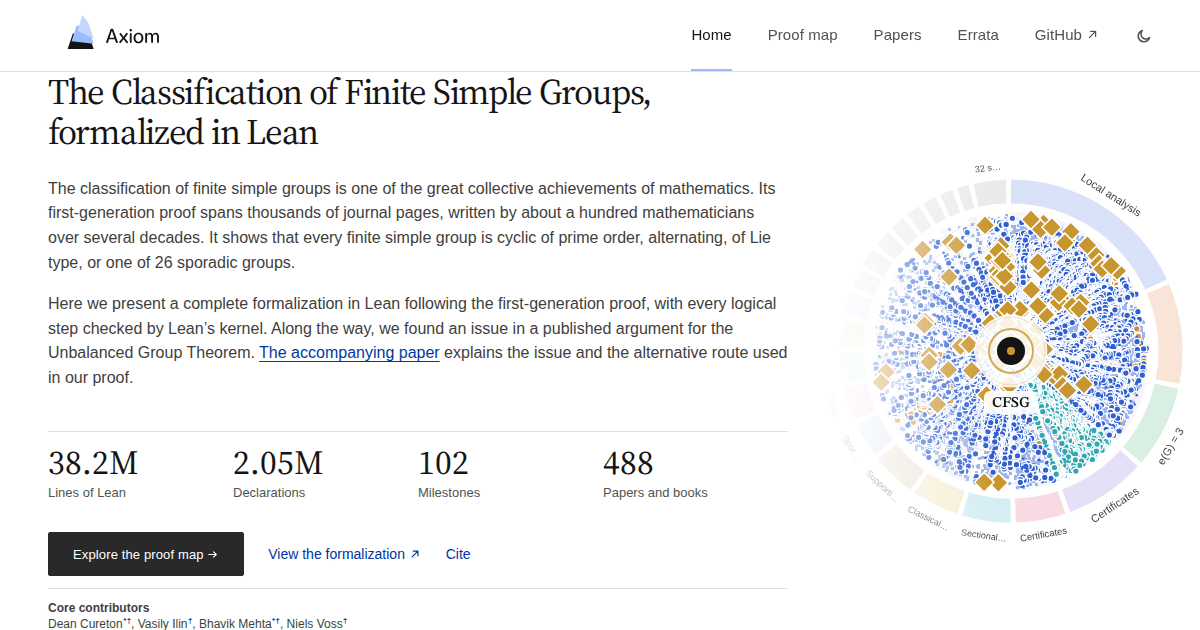
Mathematicians have successfully completed the full formalization of the Classification of Finite Simple Groups using the Lean proof assistant. This rigorous process identified a previously unknown error in the original proof, demonstrating the power of formal verification in modern mathematics.
The Formalization of a Mathematical Monument
The Classification of Finite Simple Groups (CFSG) stands as one of the most ambitious and complex achievements in the history of modern mathematics. Often referred to as the 'enormous theorem,' its original proof was the result of a decades-long, collaborative effort involving roughly a hundred mathematicians and filling tens of thousands of pages across numerous journals. The completion of a full formalization of this theorem using the Lean proof assistant represents a pivotal shift in how the mathematical community verifies foundational knowledge.
Understanding the Classification
At its core, the CFSG provides a comprehensive taxonomy of all finite simple groups. These groups serve as the 'atoms' of group theory, acting as the fundamental building blocks from which all other finite groups are constructed. The classification dictates that every such group must fall into one of four categories: cyclic groups of prime order, alternating groups, groups of Lie type, or one of the 26 exceptional 'sporadic' groups, including the massive Monster group. By formalizing this in Lean, researchers have moved the classification from a human-verified consensus to a machine-checked certainty.
The Role of Lean in Mathematical Rigor
Lean is an interactive theorem prover that allows mathematicians to write proofs in a language that a computer can parse and verify. By subjecting the CFSG to Lean’s kernel, the team ensured that every logical step—from the smallest lemma to the most complex structural argument—is computationally sound. This process is not merely a transcription; it is an active interrogation of the logic. The fact that the entire classification has now been checked by a kernel underscores the transition of mathematics toward a future where formal verification becomes the standard for major results.
Discovering the Unbalanced Group Theorem Flaw
One of the most significant outcomes of this formalization project was the discovery of an error in a published argument concerning the Unbalanced Group Theorem. In complex, multi-authored proofs of this magnitude, such oversights are statistically likely, yet they highlight the limitations of traditional peer-review processes. The formalization process forced the team to confront this gap, leading them to develop an alternative, verified route to bypass the error, thereby strengthening the entire logical foundation of the classification.
Broader Implications for Future Research
This achievement serves as a proof-of-concept for the future of mathematical research. As mathematical proofs grow in length and complexity, they often exceed the capacity for individual human oversight. The success of the Lean project suggests that formalization will become an essential tool for maintaining the integrity of the field. It provides a template for future 'megaproofs' to be verified in real-time, ensuring that the mathematical canon remains robust against the silent accumulation of errors.
Conclusion: A New Era of Certainty
The formalization of the Classification of Finite Simple Groups is more than a technical milestone; it is a cultural shift in mathematics. By successfully navigating the complexities of the first-generation proof and correcting historical errors, the project has solidified the CFSG as a verified pillar of human knowledge. This work ensures that the structural understanding of symmetry and group theory remains secure for generations of mathematicians to come.