FIFA investigates Argentina players after controversial Falklands banner celebration
Source Entity
Latest News: Today's Latest News Headlines from India & World | Hindustan Times | Hindustan Times
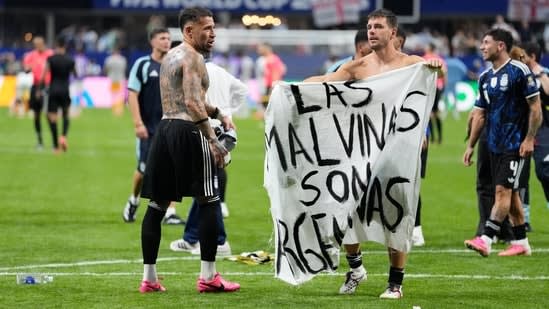
FIFA has launched an investigation into Argentina players Lisandro Martinez and Giovani Lo Celso for displaying a political banner claiming the Falkland Islands. The incident has triggered diplomatic friction between the UK and Argentina, echoing historical tensions from the 1982 conflict.
Geopolitical Tensions on the Pitch: FIFA Probes Argentina's Political Display
In a stark reminder of how sports can become a proxy for long-standing territorial disputes, FIFA has officially opened an investigation into the Argentine national team. Following a high-stakes World Cup semi-final victory over England, players Lisandro Martinez and Giovani Lo Celso sparked international controversy by waving a banner that read "Las Malvinas son Argentinas" (The Falklands are Argentinian). This act of political expression on the field has placed the players and the Argentine Football Association (AFA) in the crosshairs of FIFA's disciplinary committee, which strictly prohibits political messaging during official matches.
A History of Friction and Recurrence
This is not the first time the AFA has clashed with football's governing body over the sovereignty of the islands. The incident mirrors a 2014 event where the Argentine Football Association was fined 20,000 pounds by FIFA for displaying a similar banner before a friendly match against Slovenia. The recurrence of this behavior suggests a deep-seated cultural and national imperative within the Argentine squad to utilize their global platform to assert their claim over the islands, regardless of the regulatory risks or financial penalties imposed by FIFA.
The Shadow of 1982
The tension between England and Argentina is inextricably linked to the 1982 conflict over the Falkland Islands. Interestingly, the conflict concluded during the 1982 World Cup in Spain—a tournament where Argentina, England, Northern Ireland, and Scotland all competed. This historical intersection of football and warfare has created a unique psychological landscape for matches between these two nations, where the pitch often transforms into a symbolic battlefield for national pride and historical grievances.
Diplomatic Polarization
The reaction to the banner has followed predictable geopolitical lines, further polarizing the discourse. Argentine President Javier Milei has publicly backed the players' celebration, framing the banner as a legitimate expression of national identity. Conversely, the United Kingdom has maintained a firm stance. A spokesperson for Prime Minister Keir Starmer emphasized the UK's position, stating that while the World Cup trophy may not be theirs, the Falkland Islands definitely are. This exchange highlights how a momentary celebration by athletes can instantly escalate into a diplomatic spat between sovereign nations.
Future Implications and FIFA's Dilemma
As FIFA's independent disciplinary committee assesses the matter, the ruling will likely serve as a precedent for how the organization handles nationalistic displays in an increasingly polarized world. Given the 2014 fine, it is highly probable that FIFA will impose significant sanctions on the players or the AFA to maintain its image of political neutrality. However, such penalties often inadvertently fuel the narrative of "persecution" within the home country, potentially strengthening the players' status as national heroes in Argentina.
Summary
The investigation into Martinez and Lo Celso underscores the volatile intersection of international sport and territorial diplomacy. By invoking the "Malvinas" claim, the players have reignited a flame that has burned since 1982, forcing FIFA to balance its strict neutrality rules against the powerful currents of national identity and historical conflict.
Verification Required?