Kangana Ranaut defends those beating up students 'on the roads': Jab bolte ho toh sunna bhi padega
Source Entity
Latest News: Todays Latest News Headlines from India & World | Hindustan Times | Hindustan Times
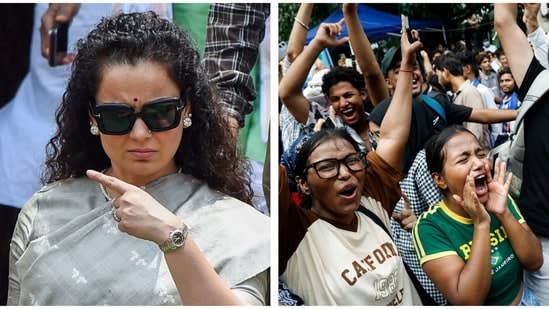
BJP MP Kangana Ranaut has sparked controversy by criticizing Gen Z protesters, labeling them as 'Generation Gutter' and defending public backlash against them. Her comments follow protests at Jantar Mantar where she alleged that abusive language was directed at the Prime Minister and his late mother.
The 'Generation Gutter' Controversy: Analyzing Kangana Ranaut's Stance
A Clash of Ideologies
BJP MP and actor Kangana Ranaut has recently ignited a fierce national debate following her sharp critique of young protesters associated with the 'Cockroach Janta Party' (CJP) movement. Ranaut, known for her polarizing public persona, utilized the term "Generation Gutter" to characterize Gen Z women participating in these demonstrations. Her commentary suggests a profound cultural divide, framing these protesters as individuals who have abandoned traditional values in favor of a lifestyle she describes as "westernised," "corrupt," and devoid of the discipline required for either academic success or domestic stability.
The Politics of Protest and Decorum
At the core of the conflict is the conduct of protesters at Delhi's Jantar Mantar. Ranaut’s primary grievance centers on the alleged use of "filthy abuse" directed at Prime Minister Narendra Modi and his late mother. By labeling such behavior as "completely unacceptable" in a democracy, the MP has positioned herself as a defender of political decorum. This incident highlights the growing tension between student-led activism and the ruling establishment, where the boundaries of free speech are increasingly tested by the use of inflammatory rhetoric.
Defending Public Retaliation
Perhaps the most controversial aspect of Ranaut's recent statements is her defense of the physical confrontations faced by protesters. Citing the physics principle that "every action has an equal and opposite reaction," she argued that protesters who use abusive language or damage public property should expect a physical response from the general public. Her assertion that "jab bolte ho toh sunna bhi padega" (if you speak, you must be prepared to listen) effectively legitimizes vigilante-style responses to political dissent, framing them as a natural consequence of the protesters' own actions.
Examining the 'Generation Gutter' Narrative
Ranaut’s sweeping generalization of young women—accusing them of flaunting drug use, alcohol consumption, and "endless body counts"—serves to delegitimize their political agency. By claiming these women seek the benefits of independent career success without putting in the necessary work, she is utilizing a classic rhetorical strategy to undermine the validity of their protest. This narrative shifts the focus away from the specific policy grievances of the CJP movement and toward a moral judgment of the protesters' character and lifestyle.
Broader Implications for Democracy
This episode underscores the volatility of political discourse in contemporary India. The involvement of law enforcement, with the Delhi Police directing social media platforms to remove offensive content, indicates that the state is actively monitoring the digital footprint of these protests. As Ranaut continues to leverage her platform to shape public perception, the incident serves as a bellwether for future political climate trends: where protest is increasingly met with moral policing, public counter-protests, and strict state intervention against perceived defamation of leadership.
Conclusion
The confrontation between Kangana Ranaut and the CJP protesters highlights a deepening fracture in the Indian socio-political landscape. While the MP advocates for a version of democracy grounded in respect for authority and traditional values, the protesters represent a younger generation pushing against those very structures. The ensuing fallout—ranging from police intervention to public physical altercations—suggests that the space for civil, non-violent political discourse is narrowing, replaced by a cycle of provocation and retaliation.
Multiple Citing Sources
Verification Required?