Utah girl tests ChatGPT, Claude & Gemini on 84 teen cases; finds empathy lacking
Source Entity
TOI TECH DESK
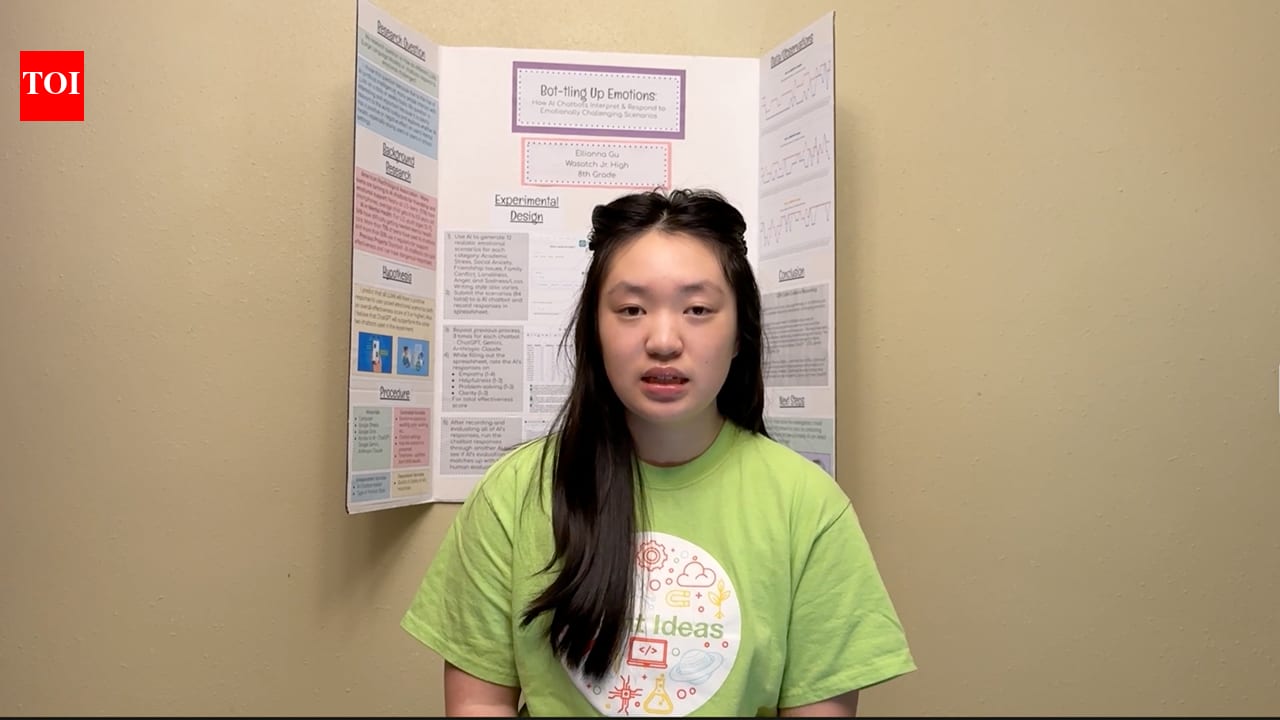
Eighth-grader Ellianna Gu conducted a study testing ChatGPT, Claude, and Gemini on 84 teenage emotional scenarios. Her research revealed that while AI provides structured information, it significantly lacks the genuine empathy required for meaningful emotional support.
The Limitations of Algorithmic Empathy: A Young Researcher's Discovery
In a recent study titled "Bot-tling up Emotions: How AI Chatbots Interpret and Respond to Emotionally Challenging Scenarios," eighth-grader Ellianna Gu embarked on a rigorous evaluation of leading artificial intelligence platforms, including ChatGPT, Claude, and Gemini. By simulating 84 distinct scenarios centered on common teenage struggles—such as academic pressure and feelings of isolation—Gu sought to determine if AI could serve as a viable tool for emotional support. Her findings highlight a critical disconnect between the structured logic of large language models and the nuanced, empathetic needs of human users.
The Methodology of Digital Inquiry
Gu’s experimental design was systematic, utilizing a range of prompts to gauge the responsiveness of these AI models. By varying the language style and formatting of her queries, she was able to observe how different linguistic inputs altered the output quality. While the chatbots consistently provided highly organized and coherent information, the core issue remained the lack of authentic emotional resonance. The study suggests that while AI excels at data synthesis, it currently fails to provide the compassionate validation that is often the primary requirement for individuals navigating mental health or emotional crises.
Contextualizing AI Risks in Mental Health
This research echoes broader concerns within the tech community regarding the deployment of AI in sensitive domains. Gu’s project references previous studies conducted by Stanford, which cautioned that AI chatbots can occasionally offer ineffective or even dangerous advice when faced with complex human emotional states. This underscores a significant safety concern: when users turn to AI for companionship or psychological guidance, the lack of a human “safety net” can exacerbate feelings of loneliness or lead to misguided coping mechanisms.
The Future of AI and Neuro-Human Interaction
Beyond her current findings, Ellianna Gu’s work is driven by a profound interest in the human brain. Her ambition to pursue future research into life-altering conditions like Alzheimer’s, Parkinson’s, and Huntington’s disease highlights a mature perspective on the intersection of technology and biology. Gu posits that understanding the brain is the key to creating better tools for support, even if current AI models remain limited by their inability to truly “feel” or empathize with the struggles they describe.
Broader Implications and Industry Trends
As AI development continues to prioritize speed and information retrieval, the gap identified by Gu’s experiment serves as a warning for tech developers. The industry is currently at a crossroads: should AI be optimized for purely transactional, logical tasks, or should there be a concerted effort to train models to better mimic human-like empathy? The results of this study suggest that until AI can bridge this emotional divide, it should be viewed as a supplemental tool for information rather than a replacement for human connection or professional psychological care.
Conclusion
Ellianna Gu’s research serves as a critical reminder that technology, no matter how advanced, operates within a framework of algorithms that cannot replicate the complexity of human experience. While these chatbots provide impressive technical performance, their inability to offer true empathy remains a fundamental barrier. As we move toward a future where AI is increasingly integrated into our daily lives, integrating human-centric design and ethical guardrails will be essential to ensure these tools remain helpful rather than harmful.