Shops looted as German cost of living protests turn violent
Source Entity
BBC News
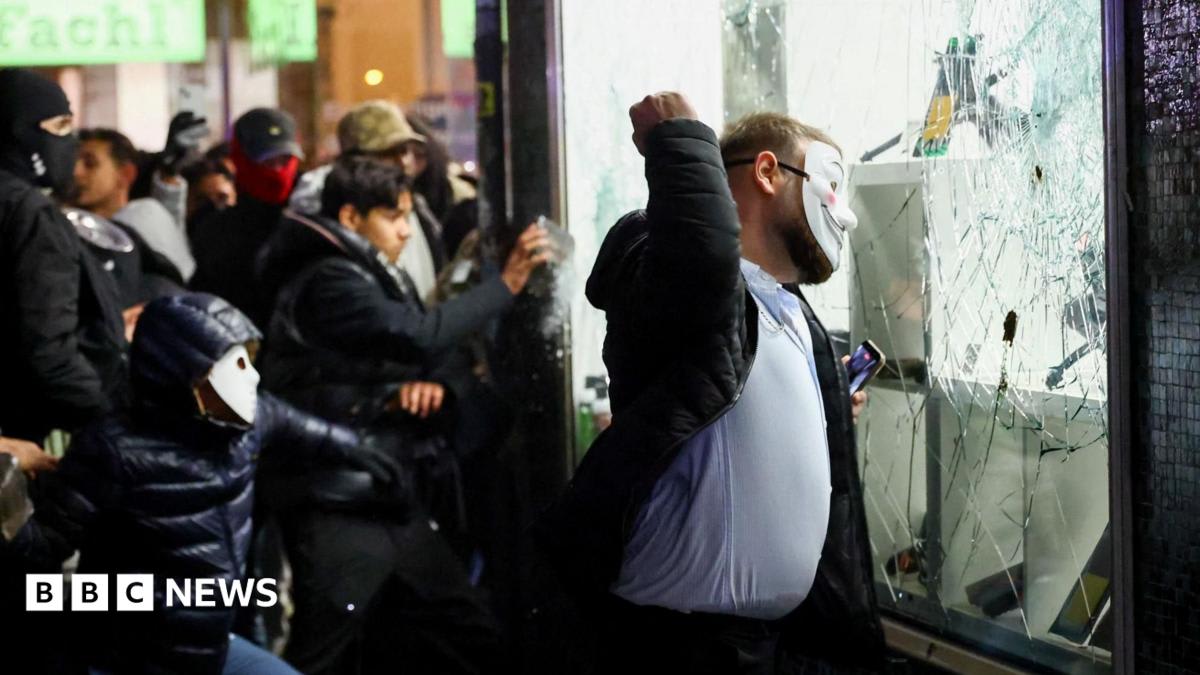
Violent protests over the cost of living and public funding cuts have erupted across major German cities, leading to looting and clashes with police. These demonstrations mirror ongoing, large-scale youth-led unrest in France, where protesters have combined political grievances with unique thematic displays.
Escalating Civil Unrest Across Europe
The recent surge of violence in Germany, particularly in the financial hub of Frankfurt, marks a significant escalation in the ongoing European protests against economic instability. While initial demonstrations were organized by the activist group Gen Z regelt to address legitimate grievances regarding school funding, public spending cuts, and the high cost of living, the situation devolved into widespread looting and direct physical confrontation with law enforcement. The use of water cannons by police in Frankfurt, Berlin, Cologne, and Hamburg underscores the severity of the threat posed by rioters who targeted emergency workers with fireworks, stones, and bottles.
The Role of Youth Activism
At the heart of these movements is a growing frustration among the younger generation. The campaign group Gen Z regelt—or "Gen Z takes charge"—has successfully mobilized thousands to demand systemic changes. Their focus on the underfunding of education and the rising cost of living highlights a disconnect between current government policies and the economic realities faced by students and young workers. This movement is not isolated to Germany; it is part of a broader, pan-European wave of youth-led dissent that seeks to hold institutions accountable for what many perceive as a failure to secure their future.
Comparing the German and French Movements
The unrest in Germany mirrors the persistent demonstrations in France, which have now entered their third consecutive weekend. While the French protests originally began with high school students addressing teacher shortages and school infrastructure, they have expanded into a multi-sector movement supported by labor unions. Interestingly, the French demonstrations have adopted a unique cultural aesthetic, with protesters utilizing Halloween costumes to deliver political messages. From characters like "Where's Wally" asking "Where is the money?" to satirical references like Marie Antoinette, the French approach reflects a creative, albeit intense, form of public pressure.
The Shift Toward Violence
Despite the initial peaceful nature of these demonstrations, the transition to violence—characterized by petrol bombs in France and looting in Germany—presents a significant challenge for European authorities. The destruction of shops and the deployment of barricades in cities like Hamburg indicate that a radicalized subset of protesters is increasingly willing to engage in criminal activity to amplify their message. This shift complicates the ability of organizers to maintain control and puts pressure on governments to balance the right to protest with the duty to maintain public safety.
Future Implications and Societal Trends
Looking ahead, these protests suggest a period of prolonged instability across the European continent. As governments struggle to balance budgets amid inflation and economic pressure, the likelihood of further clashes remains high. The synchronization of protests between France and Germany indicates that this is not merely a local issue but a systemic European crisis of confidence. Unless authorities can successfully address the underlying demands regarding public spending and economic support, the trend of youth-led mass protests—and the accompanying risk of civil unrest—is likely to continue into the foreseeable future.