In Poland, Judge Suspends Her Court's President. Protests, Coup Claim Follow
Source Entity
NDTV News Search Records Found 1000
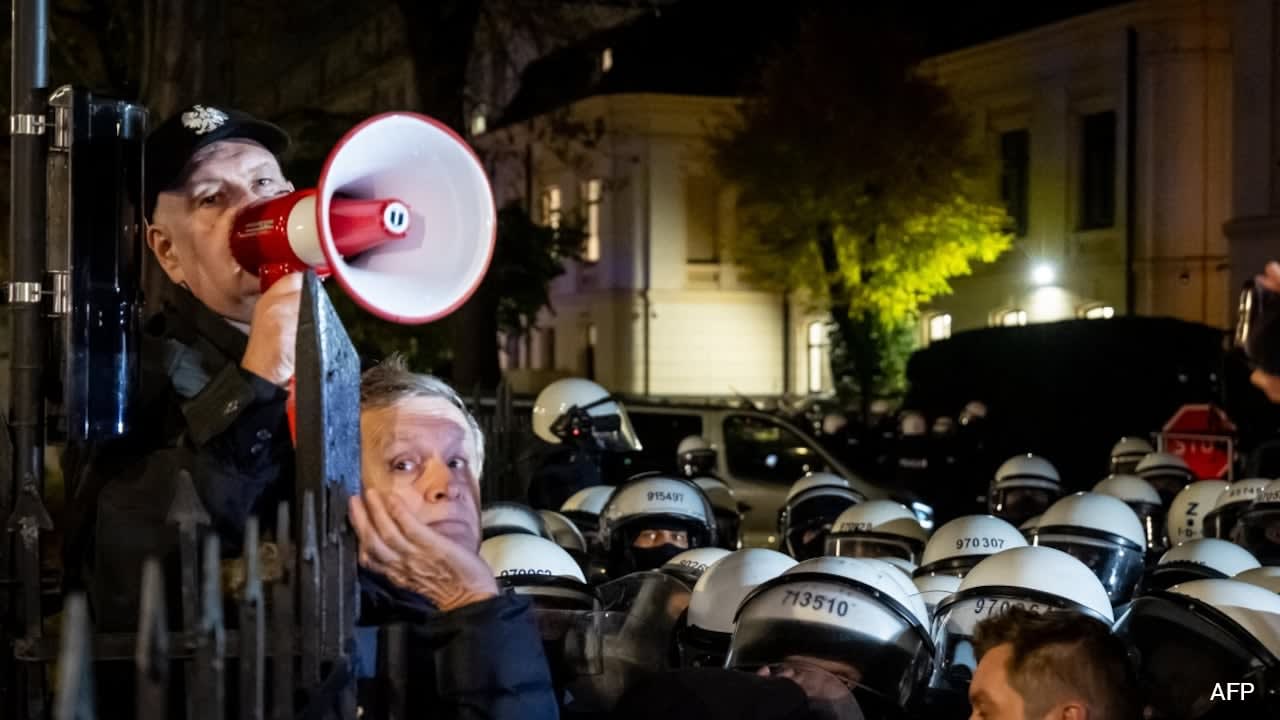
Poland is facing a severe constitutional crisis as Prime Minister Donald Tusk’s government suspends top justices, prompting a standoff at the Constitutional Tribunal. President Karol Nawrocki has returned to Warsaw amidst allegations of a 'coup d'etat' from the court and opposition.
The Constitutional Siege of Warsaw
Poland has entered a period of profound political volatility as a direct confrontation between the government of Prime Minister Donald Tusk and the Constitutional Tribunal has escalated into a physical standoff. The deployment of riot police around the Tribunal’s headquarters in Warsaw marks a significant intensification of the power struggle that has defined Polish politics for years. By suspending two senior justices, including Chief Justice Bogdan Swieczkowski, and initiating criminal proceedings against them, the Tusk administration has signaled a decisive, albeit controversial, attempt to reshape the judiciary.
The Justification of Rule of Law
Prime Minister Donald Tusk has framed these actions as a necessary, if difficult, step toward restoring the rule of law in Poland. Tusk argues that the preceding years under the Law and Justice (PiS) party were characterized by systemic lawlessness that undermined democratic institutions. From the government’s perspective, the current measures are a corrective mechanism intended to purge the judicial branch of political appointees who have allegedly obstructed the democratic process. This rhetoric highlights the deep ideological divide currently fracturing the Polish state.
The Opposition’s Allegations of a 'Coup'
Conversely, the Constitutional Tribunal and its supporters within the PiS party have characterized the government’s actions as an illegal power grab. The Tribunal explicitly labeled the suspension of its justices as a 'coup d'etat,' asserting that the individuals in question remain the only legally appointed senior justices. This binary conflict—where one side views itself as the restorer of order and the other as the victim of an unconstitutional takeover—has created a dangerous vacuum of institutional legitimacy.
Presidential Intervention and Regional Instability
The crisis reached a fever pitch when President Karol Nawrocki, a key figure backed by the PiS, abruptly cut short an official visit to Senegal. His decision to return to Warsaw to address the unfolding events underscores the gravity of the situation. The presence of police cordoning off the Tribunal building, while not yet resulting in a full physical breach, serves as a visual manifestation of a state institution in crisis, with the executive branch effectively challenging the autonomy of the judicial branch.
Historical Context and Future Implications
The Constitutional Tribunal has long been the epicenter of Poland’s rule of law dispute, serving as the primary battleground for the country’s democratic direction. This standoff is not merely a localized legal dispute but a symptom of a broader struggle between nationalist-conservative forces and the current coalition government. As the standoff continues, the uncertainty surrounding the final outcome poses a threat to Poland's political stability and its standing within international legal frameworks. The resolution of this crisis will likely determine the balance of power in Warsaw for the foreseeable future.
Multiple Citing Sources
Verification Required?